

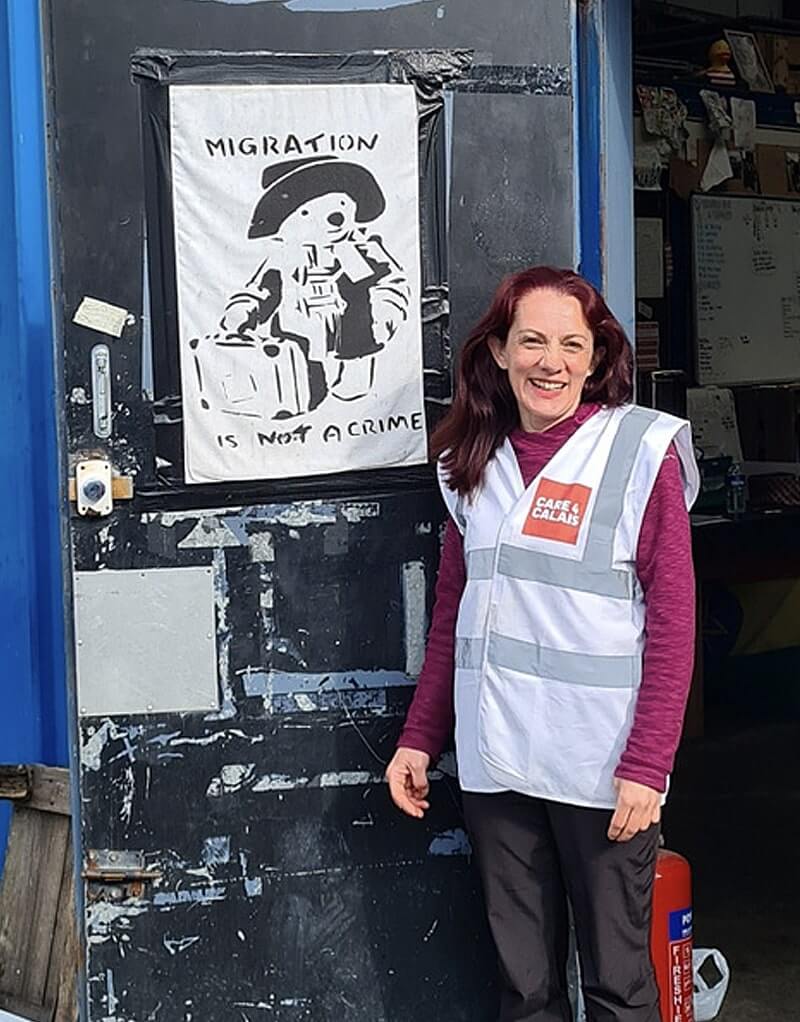
Ryn’s Care4Calais experience
Asha’s Deputy Manager, Ryn, volunteered at CARE4CALAIS in June. We thought you would find her account of her time there interesting…
It was one year, one week and one day later than intended, but I got there!
My aim was to spend time gaining a deeper understanding of the journey which asylum seekers experience. I went with an open mind and really didn’t know what to expect. It is windy in Calais and Dunkirk, and on bright sunny days, it’s cold! We spent time handing out winter coats on a sunny day in mid-May.
“There are no refugee camps in Calais” the media reports. There are refugee settlements that regularly get moved on by the Police Nationale. All these sites are windy, dusty, and cold.
Each morning a team of between 15 and 30 volunteers worked in the warehouse preparing for the afternoon sessions out in the community and stock receiving, checking, and preparing to meet the constant need for food, clothing, tents and equipment that is provided to refugees in the area.
We didn’t go out to run activities on the first day as the Police Nationale had cleared the camp over the weekend. A party of longer-term volunteers went out to try and find out where the refugees had moved to.
The volunteers came across 200+ tents on a motorway underpass all housing men from Sudan.Another party of volunteers were invited into a makeshift tent that housed three Eritrean men.
The men insisted on making coffee for the volunteers, the three guys were living in a tent made from what they could find, random bits of wood and a tarp. They didn’t have a penny between them, yet they still shared what they had.
The volunteers struggled to communicate with the Eritreans and vice versa, yet they all gestured, smiled, and shared a beautiful moment that certainly had a huge impact on the volunteers.
There are very few families in Calais as most head to Dunkirk, the volunteers did come across a lady with a toddler, they were able to connect her with children’s services, this would ensure that the mother and child were safe and had basic accommodation whilst they were in the area. Those in Dunkirk are not so lucky.
The second day we went to a site in Calais which had all young men, mostly from Sudan, South Sudan, Eritrea, Ethiopia, Nigeria. This site felt like Asha in a field! As a rule, Care4Calais doesn’t go into the camp areas to offer services, they meet people on the periphery or a designated site nearby.
The C4C team provide hot drinks, football, board games, English classes, barbering facilities, sewing and shoe repair, bicycle repair, phone charge point, music and dancing, Sim cards on request for people to get in touch with their family, and clothing distributions on set days.
The overall feeling was of immense positivity. There was a feeling of we have made it this far and it’s not much further. It is clear now why so many people we work with at Asha have melt downs, depression and struggles with their mental health once they arrive in Stoke, the realisation that the journey is a lot longer than initially thought. Getting to the UK may take several months; the asylum process is likely to take several years.
Along with the positivity there were other quieter, deeper conversations as fears and hopes played out and particularly with the high number of young men aged 14 to 18 years. A lot of what we did alongside running services was to spend time listening and having conversations with the guys that were there.
There was one conversation I had that will stay with me forever. A young lad asked: “How young do you need to be to get a mum in the UK?” The conversation was genuine. He was 14 to 15 years old, and we spent quite a bit of time chatting. He simply wanted his own mum to know he was safe and being looked after.
Another man explained how in his country young men are rounded up and forced to fight for their country, his older brother was taken in this way and unfortunately lost his life a few months later, his mum told him to leave the country, she knew this was safer than staying.

In true refugee style as the afternoon came to a close, everyone helped to pack the things back in the van, there were lots of positive smiles and gestures of ‘until next time’ wherever and whenever next time will be.
Day three was a donation jumper sort day. The all-important decision: Is it a jumper, a hoodie or a fleece? If that is the only decision, I have to make there was very little in life I had to complain about, although at times the decision was more difficult than our little team of jumper sorters had initially appreciated.
The afternoon briefing session was a little different to the day before…
“If you hear gunfire lie on the floor face down with your hands over your head, we have had gunfire on site in the past few weeks. If we tell you to leave, leave all the kit behind, don’t ask questions, just get back in the vans as quickly as possible.”
This was all said with calm intent.
The afternoon was spent at the entrance to the settlement in Dunkirk. The experience and atmosphere here was quite different, it was volatile, with young children witnessing things a child should never witness, yet they somehow accepted it as normal, continuing to play as chaos happened around them.
We offered the same services, this time working in partnership with other charities that were offering a hot meal and shower facilities from the back of a converted horse box, an essential service in such a dusty, windy environment. There were people from various African countries alongside those from Afghanistan, Iraq, Iran, Syria, Vietnam, and several South American countries.
At the end of the afternoon as we were heading back to the warehouse, 12 armoured Police Nationale vans with flashing red lights passed us heading towards Dunkirk, followed by a human rights organisation vehicle. The HRO’s role is to document police action in the area. Our hearts sank. The following day we were relieved to learn that they hadn’t cleared the site.
Two days later we went back to Dunkirk. The air was tense and we witnessed several fights/scuffles between men as the tension got too high. Other men in the area pulled them apart and peace returned.
Later in the afternoon six members of the Police Nationale came on site, looking for someone in particular, they didn’t find him, but they did heavy handedly search a guy, I felt the force and dominance wasn’t needed.
They didn’t arrest the guy or take anything off him. It felt as though he may have been used as an example to others.
The second Dunkirk day was moments of highs and low. Lows due to the tension and the authorities’ lack of respect for those that have found themselves in a situation that I am sure was not directly their choosing. Highs from beautiful conversations with amazing people.
There were three young Eritreans who knew far more about Stoke City Football Club than I did, unanimously their team was Chelsea and as we parted, they all shouted: “See you in the UK!”
There was a young girl from Ethiopia who completely whipped me at Connect 4, we were playing to her interpretation of the game, it didn’t matter either way, she couldn’t speak English, I couldn’t speak her language, but between us we shared lots of laughter and smiles.
There was a family from Iraq, mum, dad, son and granddaughter, mum was wheelchair bound, lots of thoughts went through my head of how have they travelled to Dunkirk, how do you cope in this environment, particularly with the health condition that the lady clearly had?
I have a huge amount of respect and admiration for the family’s positive spirit in such an extreme situation. I saw four or five pregnant women. I wouldn’t class myself as religious, but I did hope and pray that for a whole host of reasons these women will make it to the UK before their little peas pop into the world.
This is a slice of the experience that I had. I came away with even more respect and admiration for the people who make the journey for a better life.
I have greater appreciation of how the opportunity of having a shower, clean clothes, a shave, a haircut, a game of football or cricket, with or without the right equipment, with friends, wherever in the world that game is played, creates bonds, happy memories, and positive vibes.
And even transitory, person to person connections, offer a brief ‘timeout’ and can benefit a person’s sense of self and foster resolve.
Ryn Bentham
CONTACT US
Follow us on Facebook
Office: 01782 363122
Godfrey Seminega, Services Manager (works full-time): seminega@asha-uk.org
Jackie Gregory, Wellbeing Co-ordinator (works part-time Tuesday, Friday and occasional Saturdays): jackie@asha-uk.org
Lydia Mugoyikazi, Women’s Club Co-Ordinator and Caseworker (works part-time Tuesday, Wednesday and Saturday): lydia@asha-uk.org
Helen Ranford, Finance and Administration (works Tuesday to Friday): helen.ranford@asha-uk.org
Facinet Keita, Digital Health/IT and Unaccompanied Young People Support Worker (works Monday to Thursday): keita@asha-uk.org
Tamba Musa, Asylum Guide, Social Inclusion and Men’sSupport Worker (works Tuesday to Saturday): tamba@asha-uk.org
Charity Reg. No. 11769634 (England & Wales) Company No. CE013097
