

‘If you want to go faster, go alone. If you want to go far, go together.’
African Proverb
A MESSAGE FROM THE BOARD OF TRUSTEES
There is no doubt that without the dedication and commitment of our manager and his staff, which has been exemplary, we would not have achieved the high level of services. Under their direction our team of volunteers make an invaluable contribution. Our thanks to you all.

CELEBRATING THE ANTI-RACIST MOVEMENT
NorSCARF’ s annual Root Out All Racism event, got off to a rousing start with a robust address by Joan Walley urging a united front against racism. Ryn, Asha’s acting up deputy manager, led a panel of speakers representing Care4Calais, Stand up to Racism, the PCS Union and BARAC.
Around 100 people attended and following a shared lunch with dishes from around the world, there were creative standing-room-only workshops led by representatives of Liverpool Black LivesMatter, Merseyside Alliance for Racial Equality, Shropshire Unison, Telford Trade Union Council, and Gillian Pardesi, a local NorSCARF champion and tireless campaigner for women’s equality.
Ally, a film by Derrick Eglewogbe, was screened and afterwards Derrick led a discussion. Sue Moffatt, New Vic Borderlines, spoke about RESIST, Recognising Extremist Sentiment – Innovating Solutions, and Godfrey Seminega, Asha’s manager, spoke on fighting misinformation about asylum seekers and refugees.
It was one of NorSCARF’ s most successful annual events and it included some light relief with poetry readings by the Bard of Bucknall, Adrian N Smith.
MORE HANDS-ON-DECK!
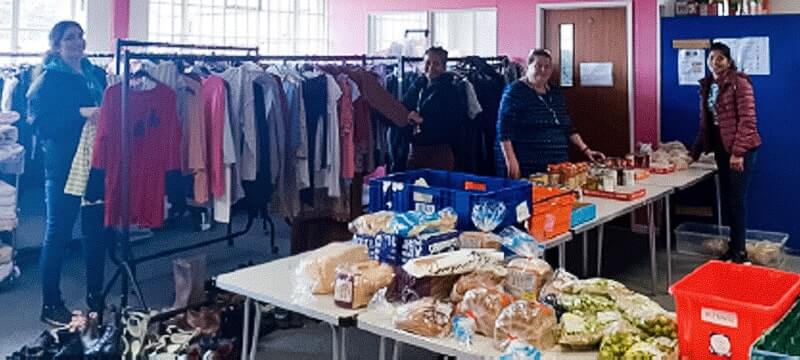
As the number of service users has increased so has the demand for helpers and Asha is pleased that it now has a dedicated team of volunteers.
The new recruits took part in a volunteer induction and training day and this was a great chance to meet one another and members of staff, and discuss their expectations and responsibilities, alongside learning about day-to-day practices in line with our health and safety and safeguarding expectations.
It was a great success leaving newly recruited volunteers feeling welcomed and confident in their abilities to begin representing the charity.
Current volunteer positions include food bank and clothing bank assistants, children’s and women’s club craft volunteers, men’s football, English teachers, befrienders, and generalist volunteers.
Since the start of the new year, we have recruited 20 new volunteers. Twelve are asylum seeking individuals currently living in hotels and eight are local volunteers.
We are lucky to be working alongside nine Keele University medical students who have all chosen to commit their time to volunteering for ASHA as part of their university degree. This month, we have also welcomed our first student placement from Stoke-on-Trent College who will complete 100 hours of volunteering as part of a Health and Social Care qualification.
The volunteers are working extremely hard to help manage the growing demands of the charity. They are incredibly dedicated, enthusiastic, and use their initiative to assist in ways to improve services.
Newly recruited asylum volunteers have commented on how they enjoy this opportunity to give back to the community and to build skills which can then support employment applications further down the line.
Those living in the hotels have expressed thanks for being given the opportunity to focus their energies on something positive whilst they have little else to do but wait for their applications to be processed.
We are excited for our volunteering team which continues to grow, opening more doors for possibilities in the future. If you have interest in supporting Asha by volunteering, please do not hesitate to get in contact.
Contact: Miriam Mamlouk
Children’s Worker and Volunteer and Befriending Coordinator
Works part time hours Monday–Friday.
ATLAS TO RECOVERY
B ‘Arts invited Asha to be part of their Atlas to Recovery project. Twenty-one women attended at least one of six weekly workshops held at Asha with storyteller Fats and textile artist Shiv, talking about stresses and sadness of having to seek asylum and the ways that people can find peace and happiness.
Women created lovely embroideries as they talked, and Shiv created a beautiful textile map which is part of an exhibition at B ’Arts alongside maps created by other community groups.
The maps were interactive and you pushed a red button and it played music and another button had the sound of making coffee, which in Eritrea and Ethiopia is an elaborate ceremony of roasting, brewing, and cupping the coffee while the host entertains guests.
The women loved this reminder of home and of the pleasure of relaxing with other women over a cup of coffee.

CELEBRATING NOWRUZ
Asha resounded with music and dancing when everyone joined in an impromptu celebration of the Iranian Nowruz or New Day which marks the traditional Iranian New Year.
The celebration was suggested by volunteers and service users and was welcomed by staff and managers.
Nowruz is also celebrated in Afghanistan and is marked by a national holiday in Albania. There was food and around 50 people enjoyed a happy and unexpected party.
TEACHING ENGLISH AND A WHOLE LOT MORE
I started teaching English during lockdown, with a few online sessions, and then moved on to see someone face-to-face for over a year, meeting for coffee in a café, because he was uncomfortable in crowds.
Once the ASHA reopened, I started weekly classes, as one of the teachers on Wednesdays, fitting in at a level above that of the entry levels of Sue and Diane, but below that of Mike, who generally deals with the more advanced students.
Things are always a little on the chaotic side in my classes, partly because there is such a wide range of ability from those who can put a few words together to those aspiring to apply for university courses.
It would be a good to have separate classes for different levels of ability, but because of other issues people just don’t come at a specific time.
I can see that in order of priority English comes below food and clothing, the welfare of children and doctors’ appointments will always be given preference.
So even when classes are divided by ability, people come along when they can.
It’s no use preparing and then delivering a class about the use of passive tenses if the people who attend need to know how to ask for a towel, a toothbrush, or a bus fare.
I generally have a range of lessons, depending on who comes. I used to have a class at one end of the main room, and sometimes the external noise from people socialising became difficult to manage.
I had to shout to make myself heard, while students who were nervous about saying anything, didn’t manage to speak much at all. We have now moved to new rooms which are ideal, well laid out, with plenty of space.
However, the students seem less keen to attend! Perhaps they feel too separated from their friends, or it’s more formal and too much like school but those who do come are probably more committed.
ASHA is really filling a gap between when people arrive in the UK and the six months wait before they become eligible to apply for entry to college. This is a time when confidence needs to be built, cultural differences explained, as well as developing a vocabulary to communicate with local people.
Since the influx of new asylum seekers to the two hotels in Stoke, more challenges have arisen. I decided to spend a couple of hours teaching in each hotel, and this was agreed with the hotel supervisory staff.
I have been given a quiet bar with tables and a flip chart in one hotel, and a multi-function room which needs rearranging each week in the other. Here the flip chart board disappeared after the first week, so I have resorted to using a hand-held whiteboard, and a projector and screen.
For new arrivals, who have been used to managing to make themselves understood in the different countries they have travelled through, ‘Google translate’ has been invaluable but in an English class, it can be quite disruptive, as people search for a suitable word in their own language and then tell others what they have found.
When creating worksheets, I might use a picture, with the English word underneath. For some people, a translation into their language still seems an essential extra step.
I have tried to write the translation for some languages, but not only is this time-consuming, it is usually inaccurate, as many English words have several nuanced meanings, which Google fails to represent. So even simple vocabulary-building results in quite a lot of discussion which is great: it just sounds a bit chaotic with so many languages being used.
What I have learned from these new arrivals is the unpredictability of people’s responses. Some refugees have been badly traumatised, and say very little, while others have learned to charm the people they meet, and superficially seem gregarious.
It is only later that I realised how everyone has been damaged in some way from the ordeal of fleeing their country and seeking asylum. It is just that some people hide their emotions better than others.
When they first arrived, the local community were generous in bringing to ASHA or directly to the hotels, lots of warm clothes. As it was just before Christmas, there were many toys which ASHA was able to distribute, which helped families entertain their children.
However, we had a very wet period, and I realised that people needed umbrellas, so I naively bought some, and took them along to my classes. No matter how many I took, there were never enough, and the classes became larger and larger until I ran out of umbrellas, and suddenly interest in English diminished!
When children started being allocated school places, W.H Smiths in Newcastle which was closing, had some cheap school bags, which again I took along. Now people in the class phoned their friends, and there was a stream of visitors knocking on the door, asking if I had any more.
This time, ASHA compiled a list of who needed school bags, and arranged more equitable distribution.
What I realised was that anything that was offered would be grabbed with some justification.
“I have three children at school.” Fairness took second place to survival, which must have been the norm during their journey to the UK.
People who had nothing became very acquisitive, and pens and paper disappeared rapidly but why not? With little disposable money, priorities would have been food and hygiene, so the extras that I provided were used beyond the classroom, and if that helped fill their spare time, it was not a problem, just an adjustment I needed to make.
Among these asylum seekers, there are people who used to work as journalists, university researchers, doctors, prospective university students and teachers, all of whom need a personalised approach to their learning.
Fortunately, there are other volunteer English teachers at ASHA who can provide some of this, including for a time some medical students from Keele, and I have also done some online correction of English in preparation for exams.
Alongside all these are families, where the children are starting to learn English in school, leaving their parents behind in their learning. It is so much more difficult to learn a language when aged over 40 if you haven’t spoken other languages in your own country.
One of the good things has been the progression over the time they have been here from the apparent selfishness of meeting basic needs to having quite supportive individuals and groups encouraging others in their learning of the language.
I am concerned about political developments from the Home Office. It seems that whatever scheme comes into the minds of those in power, it will be to create the optics of dealing effectively with a ‘problem’ of anonymous illegal invaders, rather than discerning who these individuals are, and how their access to our communities may help to improve our fractured country.
Knowing that many of the people in the hotels suffer from anxiety and depression, the idea of moving them to deliberately inhospitable venues to deter others is distressing for me, let alone those who are likely to be transferred.
Perhaps I had better avoid teaching tenses – the past is often a place which people would prefer to forget, while the future is too difficult to contemplate.
Chris, volunteer
Umbrellas wanted
If you have any spare or unwanted umbrellas, please donate them to Asha.
Thank you.
CONTACT US
Follow us on Facebook
Office: 01782 363122
Godfrey Seminega, Services Manager (works full-time): seminega@asha-uk.org
Jackie Gregory, Wellbeing Co-ordinator (works part-time Tuesday, Friday and occasional Saturdays): jackie@asha-uk.org
Lydia Mugoyikazi, Women’s Club Co-Ordinator and Caseworker (works part-time Tuesday, Wednesday and Saturday): lydia@asha-uk.org
Helen Ranford, Finance and Administration (works Tuesday to Friday): helen.ranford@asha-uk.org
Facinet Keita, Digital Health/IT and Unaccompanied Young People Support Worker (works Monday to Thursday): keita@asha-uk.org
Tamba Musa, Asylum Guide, Social Inclusion and Men’sSupport Worker (works Tuesday to Saturday): tamba@asha-uk.org
Charity Reg. No. 11769634 (England & Wales) Company No. CE013097
